BACKBLOG
 | |
| BSSF Before (1997) |
 | |
| BSSF After (2008) |
In 1997, I sold my business in Perth, Western Australia and moved back to the country. My mission: to show people there was a different way to live. I bought an 8 acre parcel of land in the south-west on the outskirts of the village of Balingup. From there my struggle with agriculture began – although I didn't know it at the time.
I'm Gavin Edwards, also known as The Self-Sufficient Farmer™ and this is the start of the end – the end of agriculture as we knew it – and the start of the new farming. The future of farming. Lisa and I have found it, invented it and lived it. To do this we used a way of living I call Self-Sufficient Farming™.
This is the land I bought – a subdivided part of a larger farm. It was good farmland, just a little run-down. There were fruit trees bearing with no irrigation (the pipe you can see was once for drawing water for what was the larger farm from the permanent creek at the bottom).

I'm Gavin Edwards, also known as The Self-Sufficient Farmer™ and this is the start of the end – the end of agriculture as we knew it – and the start of the new farming. The future of farming. Lisa and I have found it, invented it and lived it. To do this we used a way of living I call Self-Sufficient Farming™.
This is the land I bought – a subdivided part of a larger farm. It was good farmland, just a little run-down. There were fruit trees bearing with no irrigation (the pipe you can see was once for drawing water for what was the larger farm from the permanent creek at the bottom).

Here is the view in the other direction. What was to be the house site. I paid cash for the farm from the sale of the business I had in Perth – no bank loan. It was the same price as the cheapest house in the city at the time.


My folks bought the small farm over the road. It was a peach orchard and I was to run this for five years while I built my own house.


These first pictures were taken in February 1997. I transformed the two farms.
This is how our farm looked in 2008.
This is how our farm looked in 2008.
 | |
| Looking into the Kitchen garden |
 | |||||||
| Out the back door (Clives garden) |
 | |
| The Seed Garden |
 |
| Showing Dad the Seed garden |
 | |
| Looking off the front porch |
This was all done organically, despite poverty, ill health and constant harassment from government, permaculturists, neighbours, and community groups. I had planted many thousands of plants, hundreds of trees, learnt how to do an amazing amount of things - from managing an orchard, keeping animals, building, all sorts of farm skills - it was truly an amazing journey. We did it on an income which was less than what most people waste and with less water use than an average suburban house. At the same time I had amassed the largest seedbank of heritage and heirloom vegetable seeds in Western Australia, grown a great deal of our food, all our firewood and started a bookshop and an op-shop. No TV :) We were tested in every way - our relationship, personally, physically and we came through. We survived everything 'the thing' could throw at us. They didn't beat us and we became stronger and better people because of the hardship. We learned about ourselves and what we could and couldn't do, what we wanted to do and didn't want to do. I wouldn't wish what we went through to happen to anyone else. We have no regrets - we gave it our best shot - and we're still doing that. We have lived a real life.
There was even more planted by April 2012 when we sold the farm.
Why did we sell Australia's first Sustainable Small Farm™ ?
I'm writing a book about it. I hope people buy it and support our work saving food plant biodiversity and changing the future of farming.
There was even more planted by April 2012 when we sold the farm.
Why did we sell Australia's first Sustainable Small Farm™ ?
I'm writing a book about it. I hope people buy it and support our work saving food plant biodiversity and changing the future of farming.
Here's the ultra-short version and some real good advice for anyone moving to the country:
Welcome to the country - Our story.
City people are like battery hens living in cages with food provided and wastes taken away. Remember - love is the only thing that will get you through. We moved into our half built house with no toilet, power or running water. We both got the flu. We took turns chopping the wood. We worked off the farm to bring in money – whatever was going. The flu lowered my immunity and I got a 'fatal' fungal infection from handling hay. Lisa got chronic fatigue. We struggled. We had to travel about 300km to see a doctor. It cost us $200/month in medicines alone. My neighbour called in the ag dept because my blackberries had got away. I cleared two acres by hand while sick. We put 8 goats on it on tether (we won't spray) moving them twice a day. We still had no water. It got too hard and we had to leave the farm and live in the city for a year-and-a-half. I found an alternative treatment and recovered. Lisa got pregnant and I worked as a security guard. We lost the baby. I got a head wound and we packed up the truck (with concussion) and moved back to the farm. When we got back everything broke down – car, tractor, chainsaw. The other neighbour took us to court for a new fence. We struggled. We started businesses in town but the townspeople were jealous of our ideas, youth, and love for each other. We started Australia's first Sustainable Small Farm™. NEVER let them tell you it can't be done. Grow your domestic animals but leave some land for the wild animals of nature. After a while on the land your wild spirit will grow. Eventually, it will be wild and free like the wild animals. Then you are truly a country person. Our new farm is called Good Heart Farm™ – we're on the edge of the Tarkine wilderness in Tasmania. Good luck with your dreams – remember if things get tough – Love conquers all.
© Gavin Edwards 2015
I'm going to start back-blogging on the farm, time permitting, fitting the posts in order chronologically but I will mark them clearly with BACKBLOG so that people can know what was written at the time and what wasn't. We really were so ill, so constantly under attack and so busy, that we couldn't do this at the time. Hopefully this will explain what it was really like making Australia's first Sustainable Small Farm™.
We are now on our new farm, Good Heart Farm™ in Tasmania – you can catch up with what we're doing there and our continuing adventure.
Click here to go to Good Heart Farm™
Welcome to the country - Our story.
City people are like battery hens living in cages with food provided and wastes taken away. Remember - love is the only thing that will get you through. We moved into our half built house with no toilet, power or running water. We both got the flu. We took turns chopping the wood. We worked off the farm to bring in money – whatever was going. The flu lowered my immunity and I got a 'fatal' fungal infection from handling hay. Lisa got chronic fatigue. We struggled. We had to travel about 300km to see a doctor. It cost us $200/month in medicines alone. My neighbour called in the ag dept because my blackberries had got away. I cleared two acres by hand while sick. We put 8 goats on it on tether (we won't spray) moving them twice a day. We still had no water. It got too hard and we had to leave the farm and live in the city for a year-and-a-half. I found an alternative treatment and recovered. Lisa got pregnant and I worked as a security guard. We lost the baby. I got a head wound and we packed up the truck (with concussion) and moved back to the farm. When we got back everything broke down – car, tractor, chainsaw. The other neighbour took us to court for a new fence. We struggled. We started businesses in town but the townspeople were jealous of our ideas, youth, and love for each other. We started Australia's first Sustainable Small Farm™. NEVER let them tell you it can't be done. Grow your domestic animals but leave some land for the wild animals of nature. After a while on the land your wild spirit will grow. Eventually, it will be wild and free like the wild animals. Then you are truly a country person. Our new farm is called Good Heart Farm™ – we're on the edge of the Tarkine wilderness in Tasmania. Good luck with your dreams – remember if things get tough – Love conquers all.
© Gavin Edwards 2015
I'm going to start back-blogging on the farm, time permitting, fitting the posts in order chronologically but I will mark them clearly with BACKBLOG so that people can know what was written at the time and what wasn't. We really were so ill, so constantly under attack and so busy, that we couldn't do this at the time. Hopefully this will explain what it was really like making Australia's first Sustainable Small Farm™.
We are now on our new farm, Good Heart Farm™ in Tasmania – you can catch up with what we're doing there and our continuing adventure.
Click here to go to Good Heart Farm™




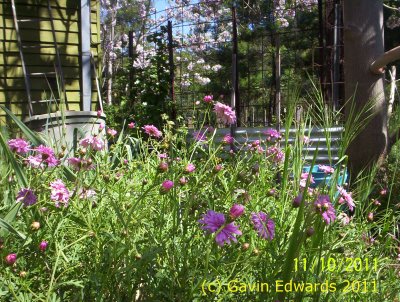

 Lisa's herb garden going mad.


